
What size should your stickers be?
A custom sticker size guide in millimetres, with every size drawn to scale on the thing it's going on.
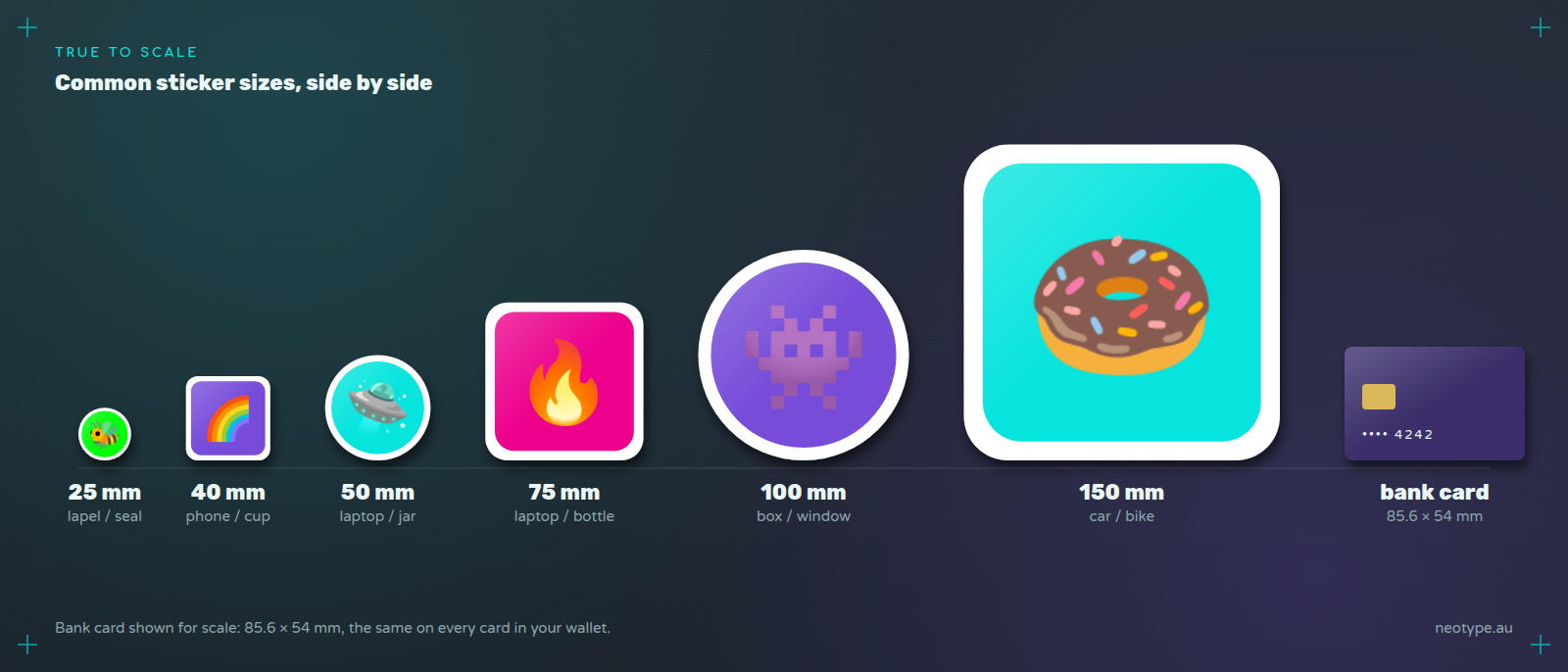
"What size should I make it?" is the question we get more than any other, and the honest answer is that it depends entirely on what the sticker is going on. So this guide is organised by object, not by size. Every picture is drawn to scale, and every number is in millimetres, because that's what the builder takes.
If you only want the short version: 50 mm for anything handheld, 75 mm for a laptop or a bottle, 100 mm and up for packaging, windows and vehicles. Those are three of the builder's one-tap presets for a reason.
Sticker sizes at a glance
| Where it's going | Sweet spot | Works from |
|---|---|---|
| Phone case | 30–40 mm | 25 mm |
| Takeaway cup, jar, tin | 40–50 mm | 35 mm |
| Water bottle, thermos | 45–50 mm wide | 40 mm |
| Laptop lid | 75 mm | 50 mm |
| Notebook, skateboard, guitar case | 75–100 mm | 60 mm |
| Mailer box seal | 60–75 mm | 50 mm |
| Shipping or product label | 100 × 60 mm | 50 × 30 mm |
| Shop window, door | 150–300 mm | 100 mm |
| Car window, bumper | 150 mm | 100 mm |
The builder takes any size from 10 mm up to 300 mm on the longest side, to the millimetre. Anything bigger is a sign job, and we'll quote it.
Laptop stickers: 50 to 100 mm
A 13-inch laptop lid is about 304 × 215 mm. A 75 mm sticker on it is the picture in everyone's head when they say "laptop sticker": big enough to read across a café, small enough to share the lid with a few friends. Go to 100 mm if it's going to be the only one on there, and down to 50 mm if you're printing something people will add to an existing collection.
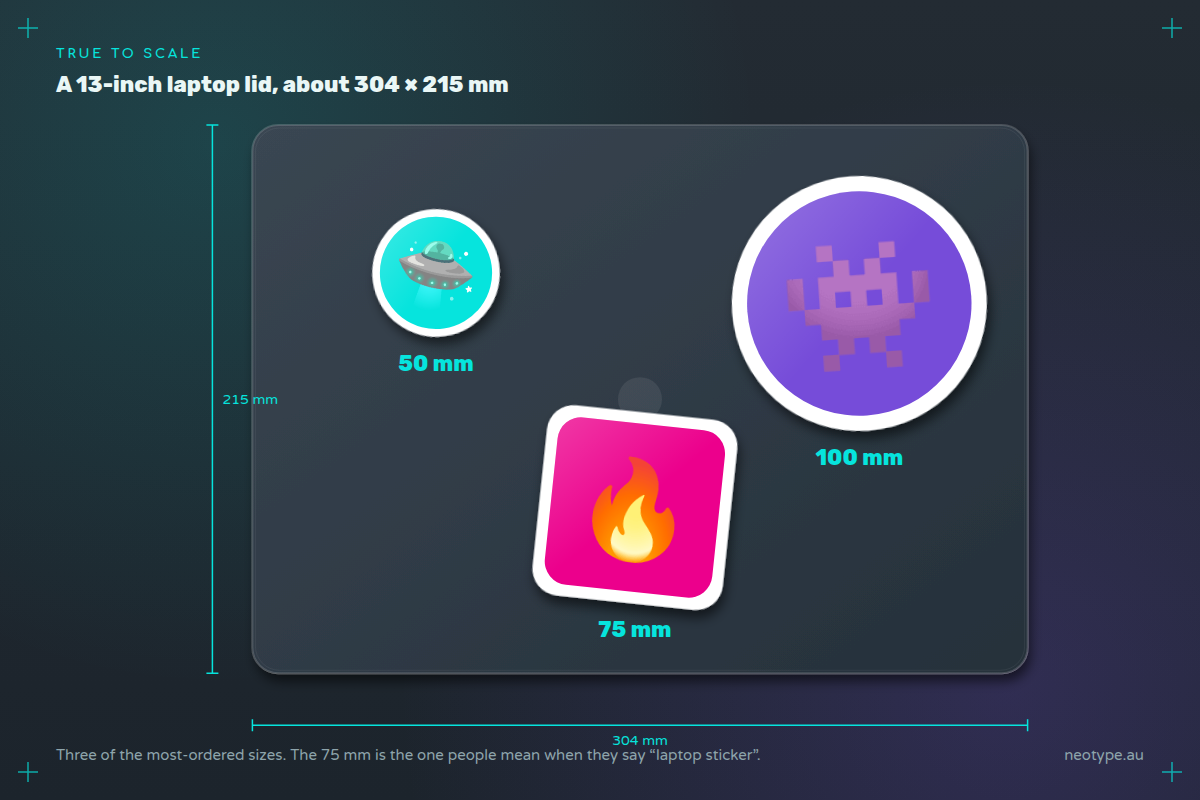
One thing the picture makes obvious that a spec sheet doesn't: on a laptop, a sticker is seen from a metre or so away. Fine detail and small type in a 50 mm design simply vanish at that distance. If your artwork has words in it, they need to be the biggest thing on the sticker.
Phones, bottles and cups: 30 to 50 mm
Anything you hold is seen from about thirty centimetres, so it can be small. The limit here isn't readability, it's curvature. Vinyl is flexible, but a wide sticker on a narrow cylinder wants to lift at the edges. Our rule of thumb: keep the sticker's width under about two-thirds of the diameter of whatever it's wrapping.
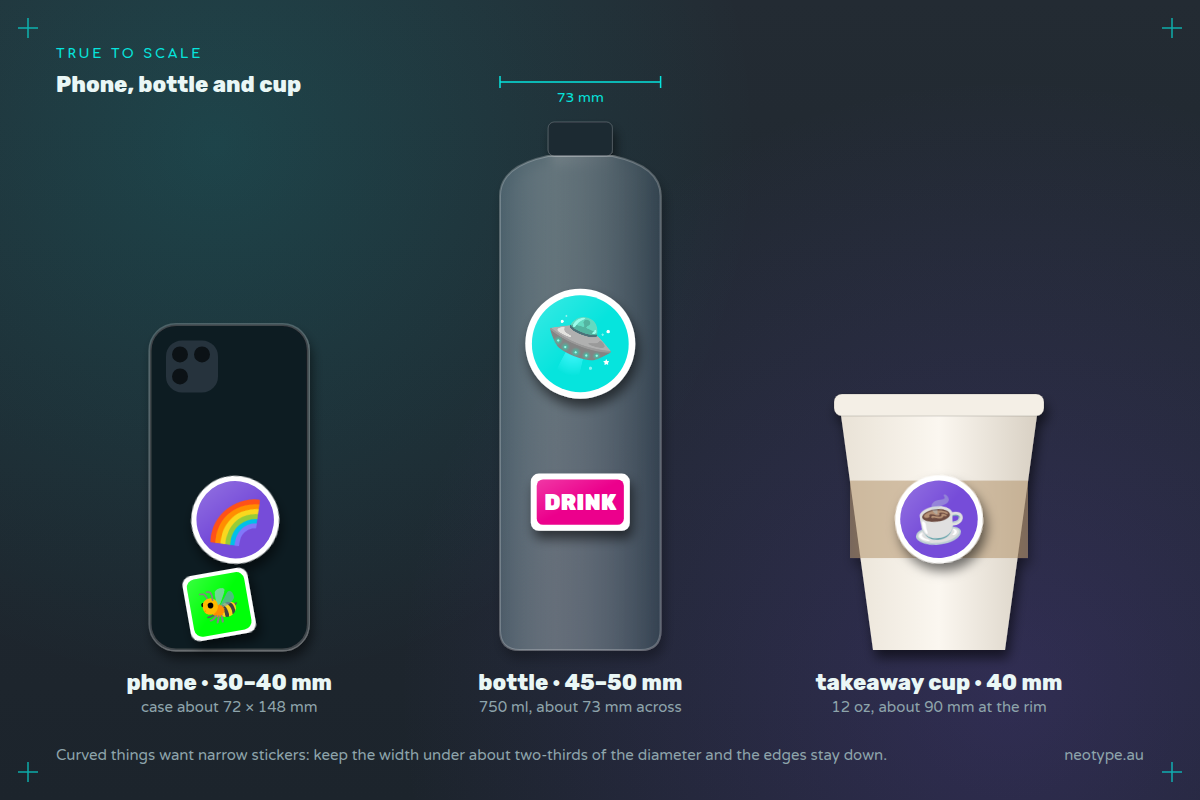
A typical 750 ml bottle is around 73 mm across, which puts the ceiling at about 50 mm wide. Tall and narrow works better than wide on a bottle: a 45 × 25 mm rectangle wraps happily where a 60 mm circle won't. Phone cases are flat, so the only limit is the camera bump: 30–40 mm keeps clear of it on nearly every model.
Packaging: seals and labels
A packaging seal has one job, to bridge the flap and hold it closed, so it needs to be big enough to sit half on each side. 60–75 mm round is the range. A product label is different: it only has to be read at arm's length, so it can be smaller than instinct says, and a rectangle almost always fits a box or a jar better than a circle does.
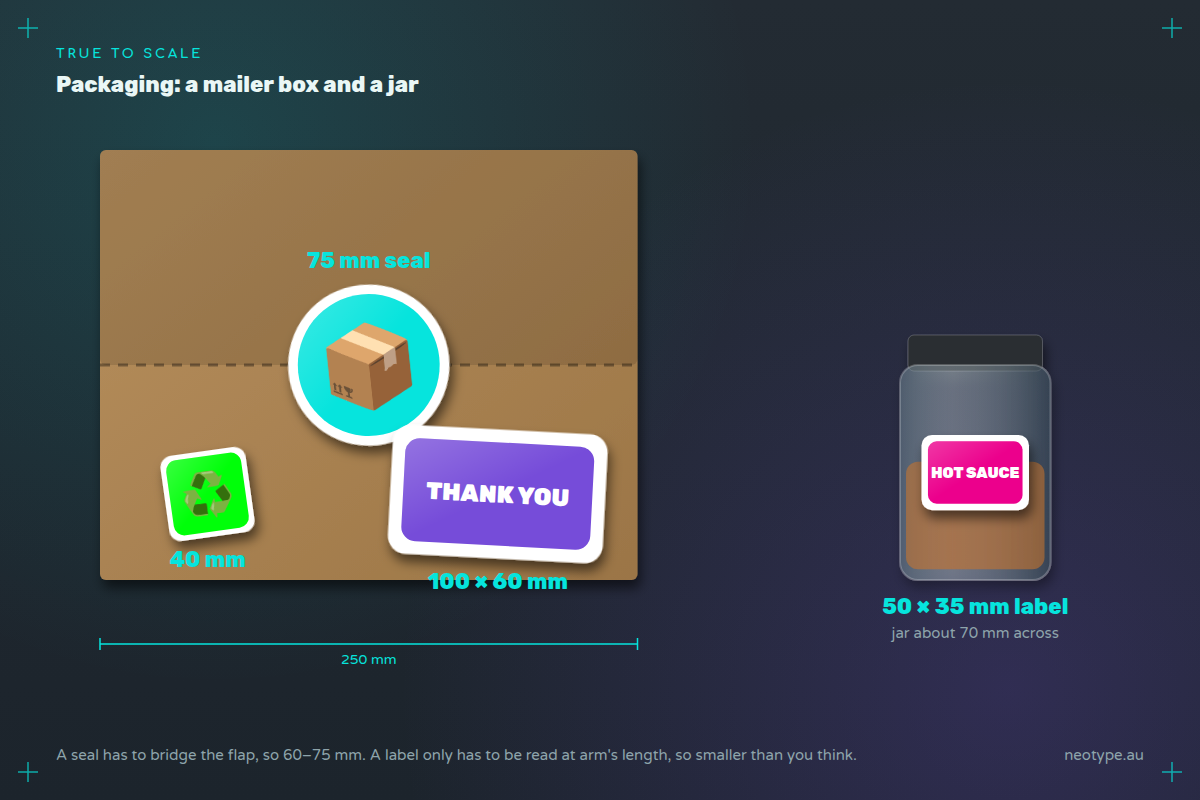
For a label with real information on it, ingredients, a batch number, a QR code, start from 100 × 60 mm and shrink until it stops being legible, not the other way round. A QR code needs about 20 mm of clear square to scan reliably from a phone, which sets a floor on any sticker that carries one.
Windows and vehicles: 150 mm and up
Outdoors the reading distance jumps from a metre to ten, and that changes everything. The old signwriter's rule is about 25 mm of letter height for every 3 metres of viewing distance. A logo that should read from across a car park needs to be 150 mm; from across the road, closer to 300 mm.
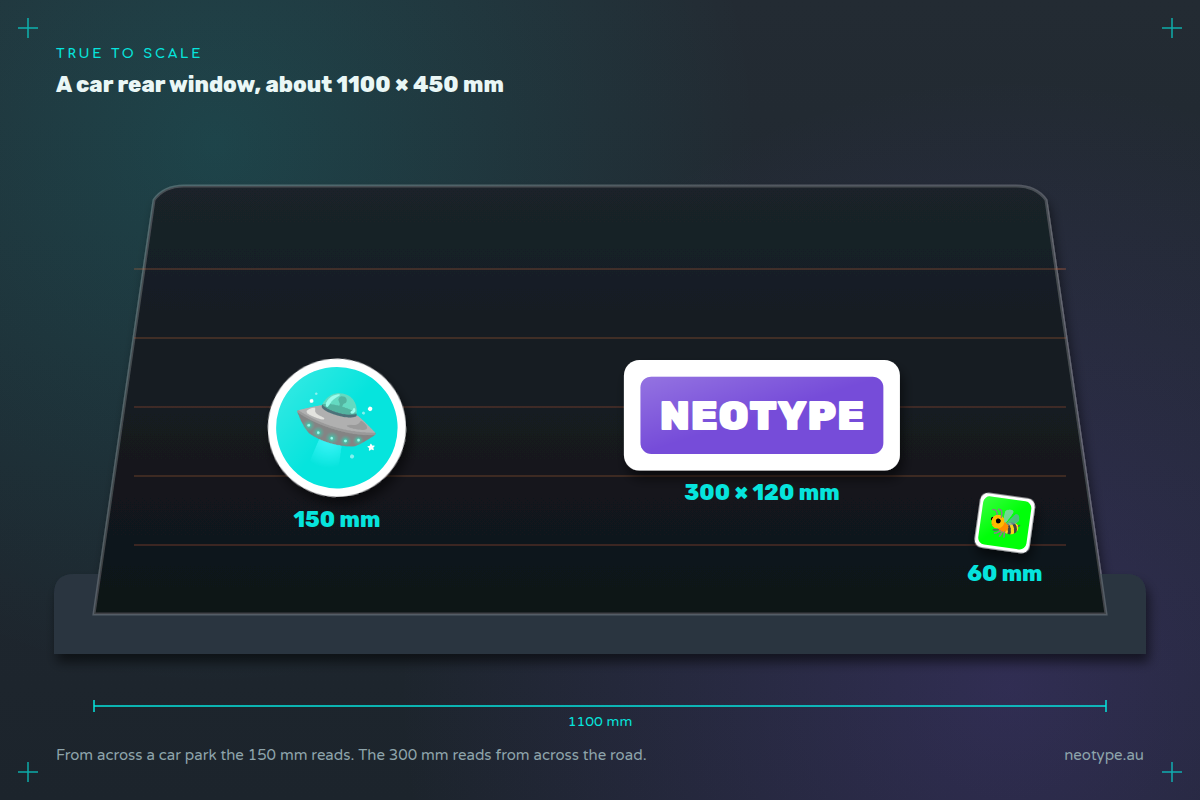
Shop windows follow the same rule, with one extra thought: a window sticker is often read from inside as well, so a clear finish printed in reverse can be the right call. Ask us if that's the job.
How size changes the price
Price follows the vinyl, and vinyl is area. Doubling the width of a sticker uses four times the material, but it doesn't cost four times as much, because the cutting and setup are the same for both. Here is the builder's own pricing for one run of a hundred matte die-cut stickers at each size, so you can see the curve.
| Size | Each, at 100 | Run of 100 |
|---|---|---|
| 25 × 25 mm | — | — |
| 50 × 50 mm | — | — |
| 75 × 75 mm | — | — |
| 100 × 100 mm | — | — |
| 150 × 150 mm | — | — |
The practical upshot: if you're torn between two sizes, the bigger one costs less extra than you'd guess. And if you're printing for a giveaway pile, going one step smaller is the cheapest way to stretch the budget, because the quantity does more to the unit price than the size does.
Three things that go wrong
- Measuring the artwork, not the sticker. The size you enter is the cut size, border included. A 50 mm sticker with a 3 mm white border has a 44 mm design inside it. Make the artwork the hero, then let the builder draw the border around it.
- Type that's fine on screen. On a phone your design fills the display. In your hand it's 50 mm. Anything under about 2 mm of letter height is decoration, not text. The artwork post covers the rest.
- Ordering one size for every job. The lid sticker, the bottle sticker and the box seal are three different sizes. Three small runs beat one wrong one.
Still not sure?
Print the design on paper at 100% and cut it out. Thirty seconds with scissors tells you more than any guide, this one included. Then put the number in the builder, where the preview is drawn at the size you enter and the price updates as you type.